
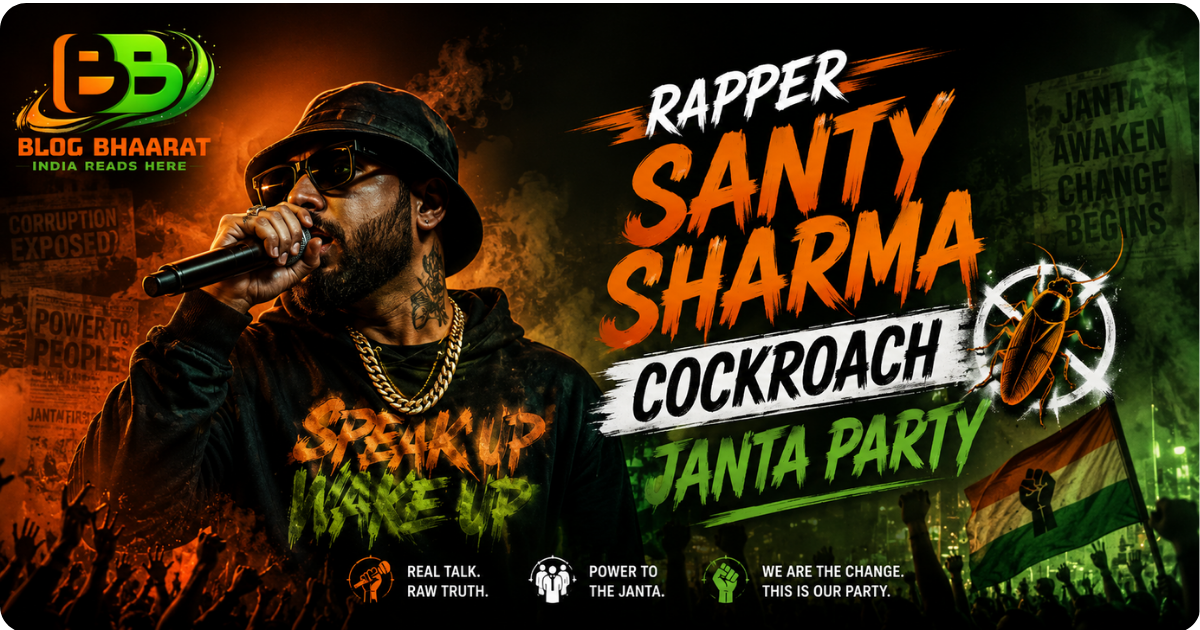
When a viral internet movement collides with the outspoken voice of an independent rapper, sparks are inevitable. That is precisely what happened in May 2026, when rapper Santy Sharma stepped into the fiery debate surrounding the Cockroach Janta Party (CJP) — one of the most explosive online phenomena to shake India’s political and social landscape in recent memory. His Instagram statement, calling the CJP nothing more than “internet drama,” triggered a fresh wave of reactions across social media and news channels nationwide.
This article takes a deep, informational dive into who Santy Sharma is, what the Cockroach Janta Party stands for, why the rapper’s remarks went viral, and what this controversy means for India’s evolving landscape of digital activism and youth expression.
Who Is Rapper Santy Sharma?
Santy Sharma is an Indian rapper, singer, and internet personality whose sharp lyricism and outspoken social commentary have earned him a dedicated fanbase across YouTube, Instagram, and streaming platforms. Working primarily as an independent music artist, Sharma is known for crafting songs that reflect trending topics — from influencer culture and internet drama to broader societal and patriotic themes.
Unlike many artists who shy away from controversial discussions, Santy Sharma has cultivated a persona of bold public engagement. He previously made headlines when he voiced support for rapper Badshah during the Tateeree controversy, establishing himself as a voice unafraid to enter turbulent public debates. He has also recently announced his debut album, titled “Reborn”, marking what fans describe as a thunderous comeback to the Indian independent music scene.
Sharma’s following is largely made up of young Indians who appreciate his unfiltered commentary on digital culture, nationalism, and the blurred line between entertainment and political discourse. His content frequently engages with current events, making him one of the few Indian rappers consistently straddling the worlds of music and social commentary.
Santy Sharma: At a Glance
Rapper Santy Sharma: Key Profile Facts
| Category | Details |
|---|---|
| Full Name | Santy Sharma |
| Profession | Rapper, Singer, Internet Personality |
| Genre | Independent Hip-Hop, Social Commentary Rap |
| Upcoming Project | Debut Album — “Reborn” |
| Known For | Bold public statements on trending issues, independent music, digital commentary |
| Previous Controversy | Publicly supported Badshah in the Tateeree controversy |
| Key Platform | Instagram, YouTube, X (Twitter) |
| CJP Statement | Called Cockroach Janta Party “internet drama” — May 2026 |
What Is the Cockroach Janta Party (CJP)?
The Cockroach Janta Party, commonly abbreviated as CJP, is a satirical political movement that burst onto India’s social media landscape in May 2026. Its name is a deliberate parody of India’s ruling party, the Bharatiya Janata Party (BJP), and it uses the cockroach — historically seen as a pest capable of surviving extreme conditions — as a symbol of resilience among India’s disenchanted youth.
The movement was founded on 16 May 2026 by Abhijeet Dipke, a political communications strategist and student at Boston University in the United States. The CJP emerged directly in response to a controversial statement made by India’s Chief Justice Surya Kant on 15 May 2026, during which he reportedly compared unemployed young people and activists to “cockroaches” and “parasites of society.” The remarks went viral within hours, triggering widespread outrage.
Rather than allowing the insult to simply fade, India’s Gen Z flipped it on its head. The hashtag #MainBhiCockroach (“I Am Also a Cockroach”) trended at number one nationally within just four hours. Dipke then formalised this energy into the Cockroach Janta Party, which presented a satirical manifesto addressing unemployment, inflation, media ownership, and governance reform.
“There are youngsters like cockroaches, who don’t get any employment or have any place in the profession.”— Chief Justice Surya Kant, May 15, 2026 (remarks that triggered the CJP movement)
The CJP Manifesto: Core Demands
The Cockroach Janta Party’s satirical manifesto resonated deeply with millions of young Indians who felt unseen by mainstream political parties. Its demands, though framed humorously, touched on very real socio-economic anxieties. The CJP called for cancellation of licenses of certain corporate-owned media houses, greater youth employment opportunities, and an end to political indifference toward young citizens.
Cockroach Janta Party: Key Facts & Timeline
| Event | Date | Detail |
|---|---|---|
| Chief Justice’s Controversial Remark | 15 May 2026 | CJ Surya Kant reportedly compared unemployed youth to “cockroaches” during a hearing |
| #MainBhiCockroach Trends Nationally | 15 May 2026 | Hashtag reached #1 in India within 4 hours of the remark going viral |
| CJP Founded by Abhijeet Dipke | 16 May 2026 | Political strategist and Boston University student formally launched the satirical party |
| 3 Million Instagram Followers Crossed | Within 78 hours | Extremely rapid social media growth |
| Surpassed PM Modi’s Instagram Handle | Within 5 days | CJP crossed 10M+ followers on Instagram |
| X (Twitter) Account Withheld in India | 21 May 2026 | CJP’s official X account was withheld in India following a legal challenge |
| Santy Sharma’s Statement Goes Viral | Late May 2026 | Rapper publicly called CJP “internet drama” on Instagram |
| Instagram Followers (Peak) | As of 23 May 2026 | Over 22 million followers — nearly double India’s government page |
Santy Sharma’s Viral Statement on the Cockroach Janta Party
As the Cockroach Janta Party dominated headlines and social media feeds, rapper Santy Sharma chose to take a clear, contrarian stance. On his official Instagram account, he published a detailed statement that quickly went viral across Instagram, X, and YouTube, generating thousands of reactions from supporters and critics alike.
In his post, Sharma described the CJP movement as feeling “more like internet drama than a serious movement.” His statement warned young Indians against blindly following online trends without properly researching the individuals behind such campaigns. He questioned the motives of the movement’s leadership and raised concerns about the political background of its founder.
“Today, many people blindly follow trends without properly researching the background of individuals leading such campaigns.”— Rapper Santy Sharma, Instagram statement on the Cockroach Janta Party
Key Points Raised by Santy Sharma
Sharma’s statement was multifaceted and addressed several dimensions of the CJP controversy. First, he pointed out the alleged political connections of the movement’s founder, noting that the CJP’s leader had reportedly been associated with the Aam Aadmi Party (AAP) and had shared social media content that Sharma described as critical of India in the past.
Second, the Indian rapper expressed concern about the source of the CJP’s social media following. He echoed claims made by a BJP Union Minister who alleged that a significant proportion of the satirical party’s followers came from accounts linked to Pakistan, Bangladesh, and what he called anti-India narratives. Sharma urged Indians to remain vigilant about digital manipulation and online propaganda.
Third, and perhaps most significantly, Sharma argued that India’s real conversations should be centred around development, employment, and national growth — not around what he called emotionally driven internet movements. He concluded his post by requesting authorities to monitor such online activities and take steps to safeguard national peace and stability.
The Debate: Reactions to Santy Sharma’s CJP Comments
The reaction to Santy Sharma’s public statement on the Cockroach Janta Party was far from one-sided. His comments ignited a fresh layer of debate within an already polarised discussion, revealing deep divisions among India’s young, digitally engaged population.
Supporters of Santy Sharma’s Position
Many social media users praised the rapper for speaking out on nationalism and digital awareness. Supporters argued that Sharma’s caution was warranted — particularly given the claims about foreign-origin social media accounts amplifying the CJP’s reach. For this segment, the Indian rapper was seen as a responsible public figure urging thoughtful engagement rather than reactive trend-chasing.
Some commentators appreciated that a prominent internet personality in the entertainment space was raising questions about the authenticity of the movement’s growth, which critics had already labelled as “online political theatre.”
Critics of Santy Sharma’s Remarks
On the other side, a vocal section of Sharma’s audience and the broader internet community pushed back strongly. Critics argued that by calling the CJP “internet drama,” the rapper was dismissing the genuine socio-economic frustrations driving millions of young Indians toward the movement. These grievances — around unemployment, inflation, education pressure, and political disillusionment — were very real, regardless of the satirical format through which they were being expressed.
Others pointed out the irony of an internet celebrity criticising online activism through the very platforms he uses to build his own brand. The debate raised broader questions about who has the authority to define what constitutes “serious” political expression in the digital age.
The CJP’s Extraordinary Growth and Cultural Significance
The scale and speed of the Cockroach Janta Party’s rise remains one of the most remarkable social media events in Indian history. Within days of its founding, the CJP had amassed over 22 million Instagram followers — nearly double the official government page’s audience. Over 350,000 people signed up through its website in the same brief period.
The movement extended beyond digital screens. Volunteers participated in offline protests and community clean-up drives dressed in cockroach costumes, transforming what began as internet satire into a tangible expression of civic participation. AI-generated images of the CJP’s cockroach mascot flooded social media feeds, news channels, and newspapers across a nation of 1.4 billion people.
As media commentator and YouTuber Meghnad S observed, the popularity of a satirical non-existent party offers a profound commentary on the state of India’s political landscape — specifically, what it means when citizens feel so unrepresented that a joke resonates more deeply than established institutions.
CJP Social Media Growth vs. Established Political Presence
| Milestone | CJP Achievement | Time Taken |
|---|---|---|
| First 3 Million Followers | 78 hours | |
| Surpassed BJP Instagram Page | 10 Million+ Followers | Under 5 days |
| Peak Instagram Following | 22+ Million Followers | 6 days |
| Website Signups | 350,000+ | First week |
| X Account Status | Withheld in India | 21 May 2026 |
| Hashtag #MainBhiCockroach | Trended #1 nationally | Within 4 hours of CJ’s remark |
Santy Sharma, Digital Activism, and India’s Changing Youth Landscape
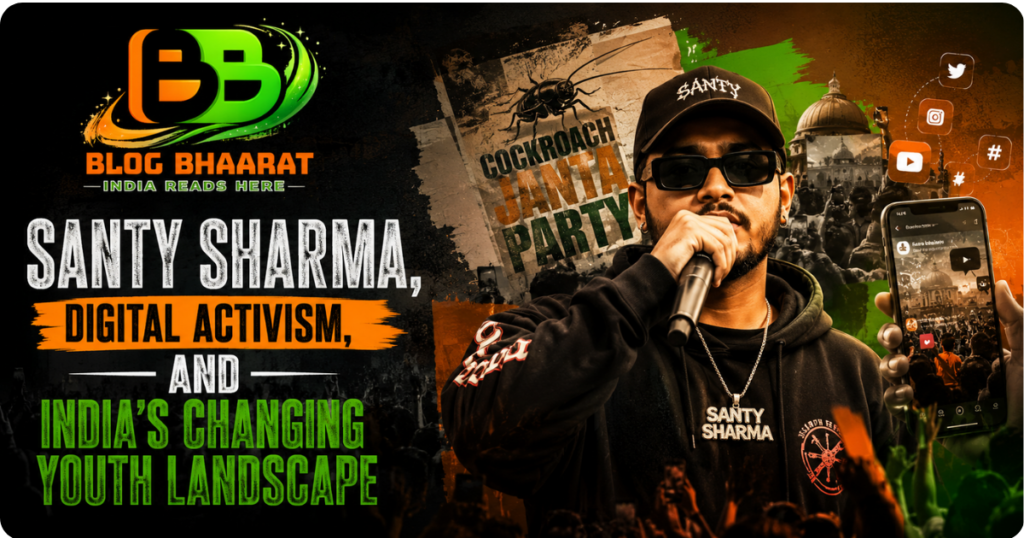
The controversy surrounding rapper Santy Sharma and the Cockroach Janta Party is a microcosm of a much larger shift happening in India. The country’s youth — the largest youth population in the world — is increasingly using digital platforms not just for entertainment, but as tools of political expression, satire, and civic engagement.
When established political parties fail to capture the imagination or address the real concerns of young voters, satirical movements fill that vacuum. The CJP’s founder himself noted that just five years ago, few people were openly willing to challenge the government; the digital environment has changed that dynamic dramatically.
Santy Sharma’s intervention raises a genuine and important question: where does responsible digital citizenship end, and where does suppression of authentic youth frustration begin? The rapper’s concerns about digital manipulation are legitimate — foreign interference in domestic social media narratives is a documented global phenomenon. However, dismissing an entire movement as “internet drama” risks overlooking the very real pain points that gave birth to it.
As an Indian rapper and cultural figure, Sharma occupies a unique position. His audience trusts him. When he speaks, they listen. That trust comes with responsibility — which is precisely why his statement generated such significant conversation. It was not merely one person’s opinion; it was a signal to millions of young fans about how to interpret a complex, nuanced political moment.
Santy Sharma’s CJP Statement: Arguments For & Against
| Perspective | Key Arguments | Broader Implication |
|---|---|---|
| Santy Sharma’s Position | CJP is “internet drama”; foreign accounts amplify it; focus should be on real national issues like employment and development | Caution around unverified viral movements; digital vigilance and nationalism |
| CJP Supporters | Movement reflects genuine youth frustration; unemployment, inflation, and political indifference are real issues | Satire as legitimate protest; Gen Z’s right to creative dissent |
| Media Analysts | CJP’s rapid growth is a commentary on Indian politics; viral movements can represent real sentiment even if satirical | Gap between establishment and youth; need for better political engagement |
| Critics of Sharma | An internet celebrity critiquing online activism through the same digital platforms undermines the argument | Questions about who defines “serious” political expression |
Conclusion
The story of rapper Santy Sharma and the Cockroach Janta Party is ultimately a story about India at a crossroads — between tradition and disruption, between caution and outrage, between satirical protest and serious political engagement. Santy Sharma’s bold decision to call the CJP “internet drama” placed him at the centre of one of 2026’s most defining online controversies.
Whether one agrees with the rapper’s stance or not, his statement forced a valuable national conversation: How do we distinguish between genuine grassroots movements and manufactured digital trends? How do we honour the frustrations of millions of young Indians while also protecting the integrity of public discourse from manipulation — domestic or foreign?
What is undeniable is that the Cockroach Janta Party — satirical, absurdist, and yet deeply earnest in its concerns — has already left a permanent mark on India’s political and cultural memory. And rapper Santy Sharma, by choosing to engage with it publicly, has cemented his own place in that conversation. In the age of digital India, silence is a choice, and Sharma chose to speak.
As India’s internet activism continues to evolve, the debate sparked by both the CJP and Santy Sharma’s response to it will serve as an important case study in the power, pitfalls, and potential of online political expression in the world’s largest democracy.
Frequently Asked Questions (FAQ)
Who is Santy Sharma?
Santy Sharma is an Indian rapper, singer, and internet personality known for his independent music and bold commentary on trending social and digital issues. He has a significant following across Instagram, YouTube, and X, and is known for engaging with high-profile controversies in the Indian digital space.
What did Rapper Santy Sharma say about the Cockroach Janta Party?
Santy Sharma posted a detailed statement on Instagram in May 2026, calling the Cockroach Janta Party “internet drama” rather than a serious political movement. He warned young Indians about blindly following online trends, raised concerns about the movement founder’s political affiliations, and alleged that a significant portion of CJP’s social media support came from accounts linked to Pakistan and Bangladesh.
What is the Cockroach Janta Party (CJP)?
The Cockroach Janta Party (CJP) is a satirical political movement founded on 16 May 2026 by Abhijeet Dipke, a political communications strategist. It emerged as a response to controversial remarks by India’s Chief Justice Surya Kant, who reportedly compared unemployed youth to “cockroaches.” The movement amassed over 22 million Instagram followers in less than a week.
Why did the Cockroach Janta Party go viral?
The CJP went viral because it transformed an insult — being called a cockroach — into a symbol of resilience and youth solidarity. It tapped into widespread frustrations among India’s young population regarding unemployment, inflation, political indifference, and media ownership. The hashtag #MainBhiCockroach trended nationally within hours, and the movement’s satirical format made it highly shareable.
How many followers does the Cockroach Janta Party have?
As of late May 2026, the Cockroach Janta Party’s Instagram page had amassed over 22 million followers — nearly double the audience of India’s official government social media pages — making it one of the fastest-growing social media accounts in Indian history.
Is Santy Sharma politically affiliated?
Santy Sharma is an independent artist and internet personality. He has not publicly affiliated himself with any political party. However, his statement on the CJP has been seen by many as aligned with a pro-establishment or nationalist viewpoint, given his concerns about the movement’s alleged foreign social media support and his emphasis on national development over internet activism.
Was the Cockroach Janta Party banned?
The CJP’s official X (Twitter) account was withheld in India on 21 May 2026 following a legal challenge. However, the movement continued to grow across other platforms, particularly on Instagram, where its following continued to climb beyond 22 million.
What is Santy Sharma’s upcoming music project?
Santy Sharma has announced his debut studio album titled “Reborn,” which he described as a comeback project after a period of hiatus. Fans have expressed excitement about the release, which promises to showcase an evolved musical identity for the rapper.



Leave a Reply