
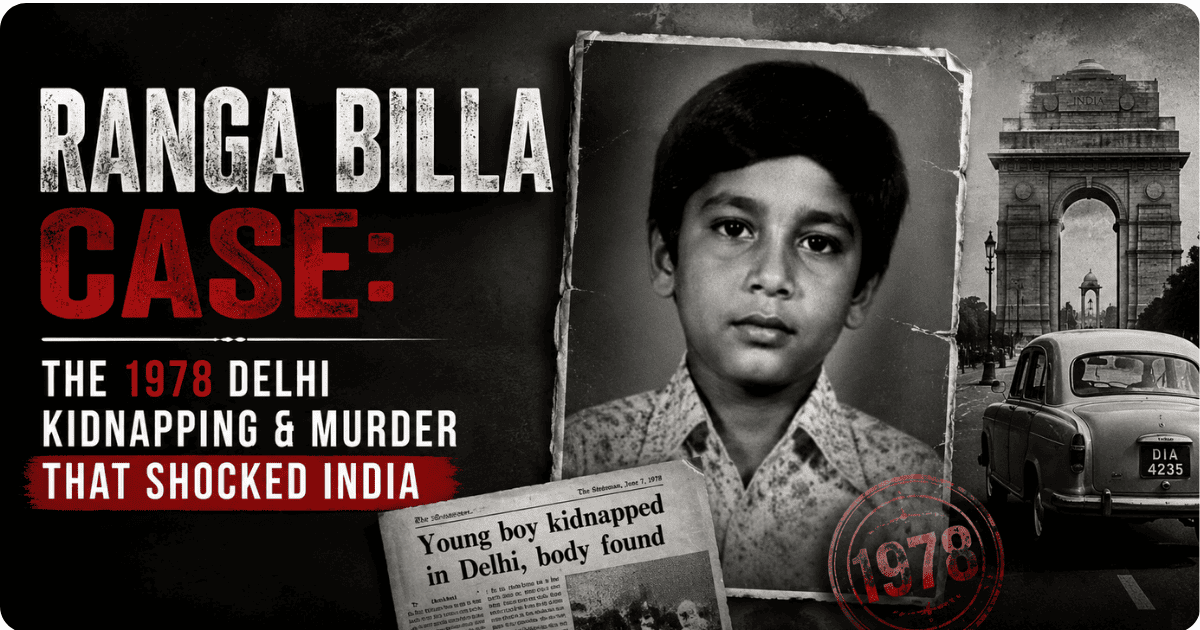
The Ranga Billa case stands as one of the most notorious criminal incidents in India’s history — a chilling 1978 kidnapping and double murder that sent shockwaves across the nation, reshaped child safety discourse, and permanently altered the course of India’s capital punishment jurisprudence. The brutal abduction and killing of siblings Geeta Chopra (16) and Sanjay Chopra (14) by Kuljeet Singh alias Ranga and Jasbir Singh alias Billa remains etched in the nation’s collective memory nearly five decades later.
Who Were Ranga and Billa? Background of India’s Most Infamous Criminals
The Ranga Billa murder case centers on two hardened criminals from Punjab who had already built a disturbing history of violent offenses before committing the crime that would define their names forever. Kuljeet Singh, known by the alias Ranga Khus, and Jasbir Singh, known as Billa, had both served time in Mumbai’s Arthur Road Jail. Upon release, they relocated to Delhi, where their criminal ambitions escalated dramatically.
Their plan on the evening of August 26, 1978, was calculated and predatory: to kidnap children, demand ransom, and eliminate witnesses if anything went wrong. The Chopra siblings were not their specific targets — they were simply young lives in the wrong place at the most dangerous time.
The Night of the Crime: August 26, 1978 — What Happened
The Geeta and Sanjay Chopra kidnapping case began in the early evening hours in New Delhi. Geeta Chopra (16) and her younger brother Sanjay Chopra (14) were the children of Captain Madan Mohan Chopra, an officer of the Indian Navy. On that fateful evening, the two siblings left their home to attend a youth programme at All India Radio (AIR). Their father was expected to collect them around 9:00 PM.
The children never arrived at the studio.
While walking and attempting to hitch a ride — a common practice in 1970s Delhi — they encountered Ranga and Billa near Dhaula Kuan. The criminals were driving a stolen mustard-colored Fiat Padmini car. They lured Sanjay into the vehicle near a sweet shop; Geeta followed after her brother’s prolonged absence. Within moments, both siblings were trapped.
The kidnappers drove the children to a forested area near Delhi Cantonment, where the crimes occurred. Witnesses later confirmed they had seen the car and noticed the children inside, some even attempting to intervene — but were unable to do so.
When the children failed to return or make contact, their family grew frantic. Reports were filed with the authorities that same night, triggering what would become one of India’s most massive manhunts.
The Manhunt, Arrest, and Forensic Evidence
The Ranga Billa case prompted a nationwide search of unprecedented scale in 1978 India. The fear was widespread — Delhi residents grew afraid to venture into public spaces. Parliament itself debated public safety in the capital. Media coverage ran for weeks.
The breakthrough came on September 8, 1978, when Lance Naik A.V. Shetty, an army soldier, spotted Ranga and Billa on the Kalka Mail train near the Yamuna River bridge. The two men had entered a railway carriage filled with soldiers as the train slowed near the Yamuna Bridge. The soldiers detained them and handed the suspects over to police upon arriving at Delhi Junction.
At the New Delhi railway station, Inspector V.P. Gupta conducted a search of the two men. The search yielded a kirpan (dagger) and bloodstains on their clothing — damning physical evidence. Forensic teams subsequently collected fingerprints and hair samples that would be critical in court.
The murder weapon was later recovered from their rented room in Agra, further cementing the chain of forensic evidence against them.
The Trial: Charges, Conviction, and the “Rarest of Rare” Doctrine
The trial of Ranga and Billa began in 1979 at the Additional Sessions Court in Delhi. Despite maintaining their innocence throughout, the weight of forensic evidence, witness testimony, and physical corroboration proved overwhelming.
Both men were convicted on multiple charges under the Indian Penal Code, including:
- Murder (Section 302 read with Section 34 — common intention)
- Kidnapping
- Kidnapping with unlawful confinement
- Kidnapping a woman with intent of sexual intercourse
- Kidnapping with intention to cause hurt
The Additional Sessions Judge sentenced both Kuljeet Singh (Ranga) and Jasbir Singh (Billa) to death, along with additional sentences of rigorous imprisonment for the supporting charges.
The Delhi High Court upheld the conviction under the bench of Justice V. Mishra and Justice F. Gill. Ranga and Billa filed a Special Leave Petition before the Supreme Court of India, which was dismissed.
The Supreme Court’s landmark judgment — Kuljeet Singh alias Ranga v. Union of India (1981 AIR 1572) — became one of the most quoted rulings in Indian criminal jurisprudence. The court stated in unequivocal terms:
“The survival of an orderly society demands the extinction of the life of persons like Ranga and Billa who are a menace to social order and security. They are professional murderers and deserve no sympathy even in terms of the evolving standards of decency of a maturing society.”
This case is now consistently cited alongside Bachan Singh v. State of Punjab (1980) as a defining benchmark for the “rarest of rare” doctrine in Indian death penalty jurisprudence. Their mercy petitions were subsequently rejected by the President.
Execution: January 31, 1982 — Tihar Jail
Ranga and Billa were hanged at Tihar Jail, New Delhi, on January 31, 1982 — nearly four years after the crime was committed.
Historical accounts note that the execution was notably grim. The lever was reportedly pulled with such force that there were physical consequences so severe they were documented in later historical writings, including Sudeep Chakravarti’s 2024 book Fallen City: A Double Murder, Political Insanity, and Delhi’s Descent from Grace.
Neither the families of Ranga nor Billa accepted the bodies. Their last rites were performed by Tihar Jail itself. Former Tihar Jail superintendent Sunil Kumar Gupta, who oversaw the hanging, later publicly opposed capital punishment, arguing it systematically disadvantages the economically marginalized — a debate that the Ranga Billa case continues to fuel to this day.
Key Facts of the Ranga Billa Case at a Glance
| Detail | Information |
|---|---|
| Date of Crime | August 26, 1978 |
| Location | New Delhi, India (near Dhaula Kuan & Delhi Cantonment) |
| Victims | Geeta Chopra (16) and Sanjay Chopra (14) |
| Victim’s Father | Captain Madan Mohan Chopra (Indian Navy Officer) |
| Accused | Kuljeet Singh alias Ranga; Jasbir Singh alias Billa |
| Vehicle Used | Stolen mustard-colored Fiat Padmini |
| Arrested | September 8, 1978 (Kalka Mail train, near Yamuna Bridge) |
| Arresting Officer | Lance Naik A.V. Shetty (Indian Army); Inspector V.P. Gupta (Delhi Police) |
| Trial Start | 1979, Additional Sessions Court, Delhi |
| Conviction | Multiple charges including murder, kidnapping, assault |
| Sentence | Death penalty (upheld by Delhi HC and Supreme Court) |
| Date of Execution | January 31, 1982, Tihar Jail, New Delhi |
| Legal Landmark | Kuljeet Singh v. Union of India (1981 AIR 1572) |
| Posthumous Honours | Kirti Chakra (both siblings); Sanjay Chopra Award; Geeta Chopra Award |
| Screen Adaptations | Black Warrant (Netflix, 2025); Raakh (Amazon Prime Video, 2026) |
The Lasting Legacy: Child Safety, Bravery Awards, and Cultural Impact
The Chopra sibling kidnapping case left an indelible mark on Indian society that extends far beyond the courtroom.
National Bravery Awards in Their Memory
In 1978, the Indian Council for Child Welfare instituted two of the most prestigious children’s bravery honours in the country, specifically in memory of Geeta and Sanjay:
- The Sanjay Chopra Award — given annually to children under 16 who demonstrate extraordinary bravery
- The Geeta Chopra Award — recognizing courageous acts by young girls
Both siblings were also posthumously awarded the Kirti Chakra, one of India’s highest peacetime gallantry awards.
Impact on Child Safety and Public Policy
The Ranga Billa murder case fundamentally changed how India thought about child safety in public spaces. It prompted urgent parliamentary debate about policing infrastructure in Delhi and set in motion early conversations about stranger danger, public safety norms, and protection protocols for minors that continue to evolve today.
Influence on Death Penalty Jurisprudence in India
The case’s legal ripple effect is profound. Kuljeet Singh alias Ranga v. Union of India is among the most cited judgments when Indian courts deliberate on the “rarest of rare” doctrine. It is referenced in discussions about the Nirbhaya case, academic articles on capital punishment reform, and legal proceedings across the country. For those studying Indian criminal law and capital punishment, this case represents a cornerstone moment.
Ranga Billa Case in Popular Culture: Black Warrant and Raakh
Nearly five decades after the crime, the Ranga Billa case has experienced a powerful cultural resurgence through streaming adaptations.
Black Warrant (Netflix, 2025)
Directed by Vikramaditya Motwane, the Netflix series Black Warrant premieres on January 10, 2025, and dedicates an entire episode to the Ranga and Billa story. The show explores the criminals’ psychology, their capture, and the societal fallout. The series is based on the memoir of a former Tihar Jail superintendent and provides an immersive look at life inside one of India’s most famous prisons during the era of Ranga and Billa’s incarceration.
Raakh (Amazon Prime Video, 2026)
Raakh, streaming on Amazon Prime Video, stars Ali Fazal, Sonali Bendre, Aamir Bashir, Dibyendu Bhattacharya, and Rakesh Bedi. While it is a fictionalised adaptation with invented characters and subplots, the series draws unmistakably from the 1978 Chopra kidnapping case. Set in 1970s New Delhi, it functions not merely as a crime procedural but as what critics have described as a grief document about a country — exploring the systemic failures, the alternate timelines, and the haunting “what ifs” of that night.
These adaptations have reignited public interest in the Ranga Billa case, introducing a new generation to one of India’s darkest true crime chapters.
Procedural Controversies and Unanswered Questions
While the conviction of Ranga and Billa is widely accepted, legal scholars and investigators have noted several procedural irregularities:
The suspects’ photographs were released to national media before sufficient evidence was formally established — a practice that legal scholars noted could legally contaminate witness identifications. Senior Crime Branch officers made contradictory public statements: some maintained Geeta was not assaulted, yet official records of Ranga’s confession stated otherwise. The murder weapon was found in what critics called “the most obvious possible place” — the accused’s rented Agra room.
These documented procedural failures, acknowledged even in court, added a layer of legal complexity to a case that was otherwise treated as settled by public opinion. They did not alter the final outcome but continue to serve as cautionary lessons in Indian forensic and investigative practice.
Conclusion: Why the Ranga Billa Case Still Matters in 2026
The Ranga Billa case is not merely a historical footnote. It is a living legal precedent, a cultural touchstone, and a sobering reminder of what can happen when systemic failures converge with premeditated violence. The courage of Geeta and Sanjay Chopra — two teenagers who faced unimaginable horror — transformed a tragedy into a legacy of bravery that India continues to honour every year through national awards.
From courtrooms citing Kuljeet Singh v. Union of India in capital punishment debates, to streaming platforms revisiting the story for new audiences via Raakh and Black Warrant, the case refuses to be forgotten. It lives on in law books, in bravery certificates handed to courageous children, and in the enduring question it poses to Indian society: are we doing enough to protect the vulnerable?
For further reading on India’s criminal justice history and landmark cases, explore resources at India Law Portal and Supreme Court of India’s official database.
Frequently Asked Questions (FAQs) About the Ranga Billa Case
1. Who were Ranga and Billa in the 1978 Delhi case?
Ranga and Billa were the criminal aliases of Kuljeet Singh (Ranga Khus) and Jasbir Singh (Billa) — two men from Punjab with prior criminal records who kidnapped and murdered siblings Geeta Chopra (16) and Sanjay Chopra (14) in New Delhi on August 26, 1978. Both were convicted and executed at Tihar Jail on January 31, 1982.
2. What happened to Geeta and Sanjay Chopra?
Geeta and Sanjay Chopra were siblings abducted by Ranga and Billa near Dhaula Kuan in New Delhi while they were on their way to All India Radio for a youth programme. The children were driven to a forested area near Delhi Cantonment, where they were assaulted and murdered. Their father, Navy Captain M.M. Chopra, was to collect them later that evening — but they never arrived at the studio.
3. What is the legal significance of the Ranga Billa case?
The Kuljeet Singh alias Ranga v. Union of India (1981 AIR 1572) judgment is one of India’s landmark criminal law rulings. It is consistently cited as a defining precedent for the “rarest of rare” doctrine governing capital punishment in India, alongside Bachan Singh v. State of Punjab (1980). The case established that professional, premeditated murderers with no prospect of reformation warrant the death penalty.
4. What awards were given to Geeta and Sanjay Chopra?
Both siblings were posthumously awarded the Kirti Chakra, one of India’s highest peacetime gallantry medals. In their memory, the Indian Council for Child Welfare established the Sanjay Chopra Award and the Geeta Chopra Award in 1978 — given annually alongside the National Bravery Awards to children under 16 who demonstrate exceptional courage.
5. Which OTT shows are based on the Ranga Billa case?
Two major streaming productions are based on or inspired by the Ranga Billa case: Black Warrant (Netflix, January 2025), directed by Vikramaditya Motwane, which explores the criminals’ story through the lens of Tihar Jail; and Raakh (Amazon Prime Video, 2026), starring Ali Fazal and Sonali Bendre, a fictionalised investigative crime thriller set in 1970s New Delhi that revisits the Chopra kidnapping.
You May Also Read – Dridam: Meaning in Sanskrit & Telugu, and the 2026 Malayalam Crime Thriller
Follow Us On –Facebook, Instagram, Youtube, Twitter, Linkedin, Pinterest, whatsapp Channel