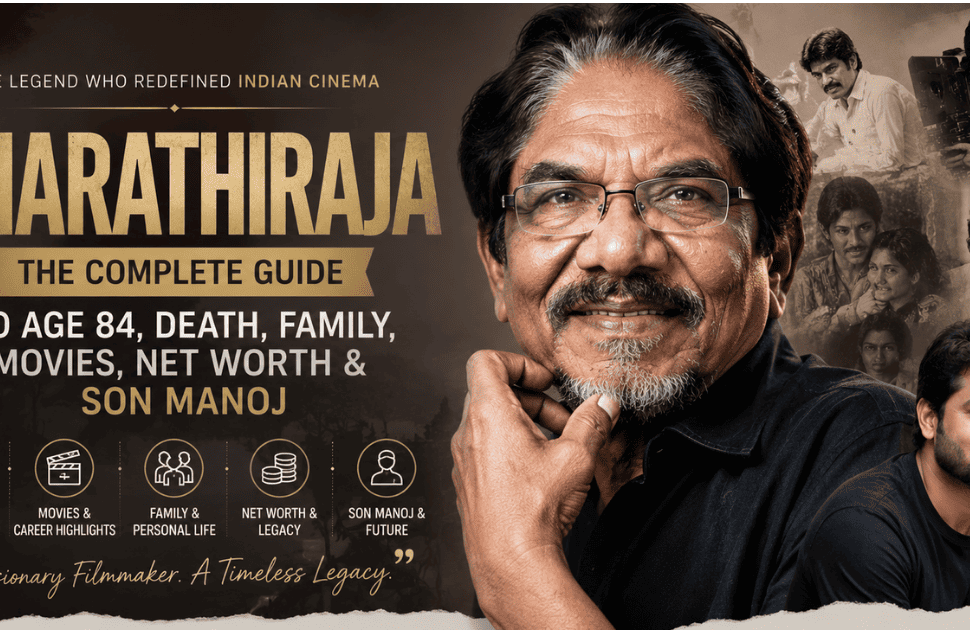
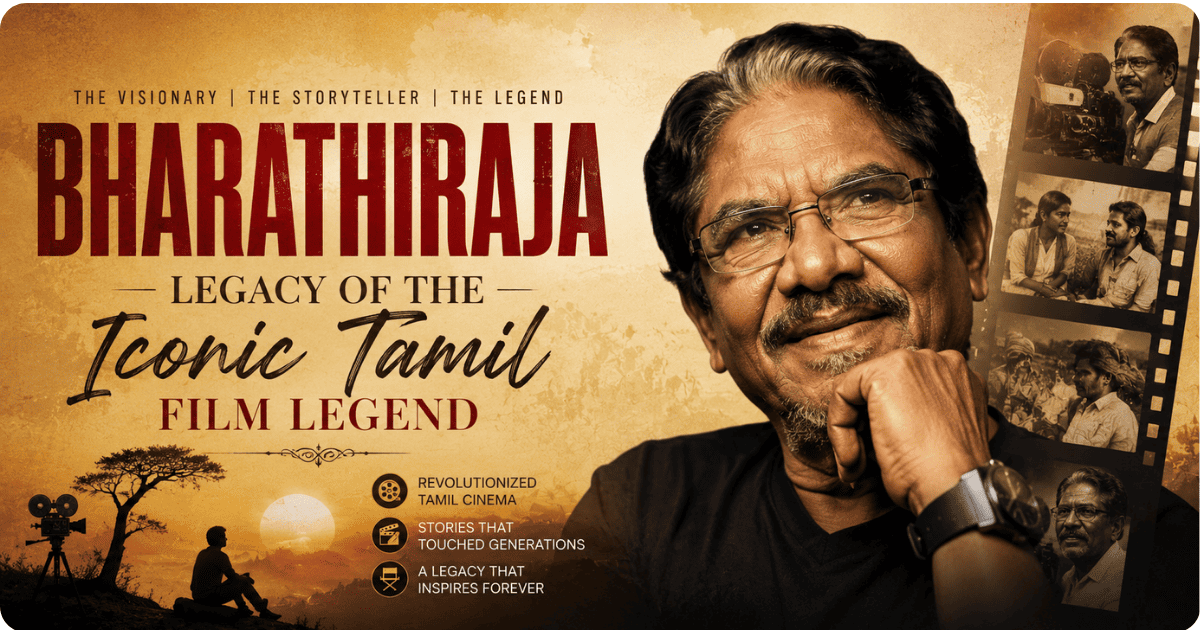
Bharathiraja’s legacy is that of a director who took Tamil cinema out of closed studios and into real villages, giving rural stories, characters, and landscapes a permanent place on the big screen. He combined powerful social themes with emotionally rich storytelling, inspiring generations of filmmakers across India and redefining what mainstream Tamil films could look and feel like.
Who Was Bharathiraja?
Bharathiraja (born Chinnasaamy Periyamaya Thevar) was an Indian film director, producer, screenwriter, and actor who primarily worked in the Tamil film industry. He was widely known for his realistic and sensitive portrayals of village life and for pioneering what is now called “rural Tamil cinema.”
He made his directorial debut in 1977 with the landmark film 16 Vayathinile, which broke away from studio-shot, urban-centric stories and embraced real locations and rural characters. Over a career spanning nearly five decades, he directed dozens of films, introduced many new talents, and became one of the most decorated filmmakers in South Indian cinema.
Early Life and Journey into Cinema
Bharathiraja was born on 23 August 1942 in Allinagaram in the then Madura District of the Madras Province (now Theni district) in Tamil Nadu. Growing up in a rural environment heavily informed his visual style and narrative interests, especially his focus on villages, farming communities, and the rhythms of countryside life.
He initially worked in various roles before becoming a director, including stints in television and assisting in film work, which gave him a solid grounding in both the technical and narrative aspects of cinema. These experiences sharpened his storytelling instincts and prepared him to challenge the dominant studio system of the time.
Breaking the Studio Mold: The Arrival of 16 Vayathinile
When 16 Vayathinile released in 1977, Tamil cinema was largely dominated by films shot on controlled studio sets with formulaic narratives. Bharathiraja chose a radically different approach, shooting extensively on live locations and building a story rooted in village realities, complex relationships, and emotional vulnerability.
The film not only introduced a more naturalistic visual language but also redefined the audience’s expectations of what a “commercial” Tamil film could be. It became a cult classic and is widely considered a turning point that opened the doors for rural-centric narratives and location-based shooting in mainstream Tamil cinema.
Landmark Films That Shaped His Reputation
Some of Bharathiraja’s most influential films include 16 Vayathinile, Muthal Mariyathai, Vedham Pudhithu, Kizhakku Cheemayile, Karuththamma and Anthimanthaarai. Each of these films explored rural life with visual authenticity and emotional depth, often focusing on marginalized voices and complex social dynamics.
Signature Themes and Storytelling Style
Bharathiraja’s cinema is best known for three broad qualities: its realistic rural imagery, strong emotional cores, and willingness to question social structures. He consistently blended visually rich landscapes with intimate stories, making villages not just backdrops but central characters in themselves.
He often portrayed women as layered, central characters, exploring their relationships, desires, and struggles against social constraints. His films also tackled issues like caste discrimination, honour, and social injustice, weaving them into narratives that were still accessible and engaging for mainstream audiences.
Common Social Themes in Bharathiraja’s Films
| Social theme | How it appears in his films |
|---|---|
| Caste and social hierarchy | Characters struggle against rigid caste boundaries and question inherited injustices. |
| Women’s agency and dignity | Women often drive the story, making crucial moral and emotional choices. |
| Rural poverty and aspiration | Village characters chase dignity, love, or escape despite harsh economic realities. |
| Clash between tradition & change | Generational conflicts highlight the tension between old values and new ambitions. |
Visual Language: Taking the Camera to the Villages
One of Bharathiraja’s biggest contributions was moving Tamil cinema away from indoor sets towards real landscapes and live locations. At a time when most films were shot inside studios, he took cameras into fields, riversides, village streets, and rural homes, giving audiences an immersive sense of Tamil Nadu’s countryside.
This shift did more than add visual beauty; it changed how filmmakers thought about authenticity and scale. His framing of fields, hills, rain, and village architecture became a visual signature that many later directors tried to emulate.
Bharathiraja’s Visual Style at a Glance
| Visual element | Characteristic in his work |
|---|---|
| Locations | Real villages and outdoor landscapes dominate the screen. |
| Camera movement | Fluid, often following characters through fields and narrow village lanes. |
| Use of nature | Rain, rivers, crops, and open skies amplify emotional beats and turning points. |
| Colour and texture | Earthy tones, simple costumes, and non-glamorous settings create grounded realism. |
Awards, Honours, and Critical Recognition
Bharathiraja stands among the most decorated directors in Indian cinema, especially in the Tamil industry. Over the years, he accumulated major national and regional awards that reflected both critical and institutional recognition of his work.
As of 2017, he had won six National Film Awards, four Filmfare Awards South, six Tamil Nadu State Film Awards, and a Nandi Award. The Government of India honoured him with the Padma Shri, the country’s fourth-highest civilian award, in 2004 for his contribution to cinema.
Snapshot of His Major Awards
| Award type | Count / recognition |
|---|---|
| National Film Awards | Six, across different films and categories. |
| Filmfare Awards South | Four, acknowledging his impact in regional cinema. |
| Tamil Nadu State Awards | Six, reflecting strong state-level acclaim. |
| Nandi Award | One, highlighting his work beyond Tamil cinema. |
| Civilian honour | Padma Shri (2004) from the Government of India. |
These numbers underline how consistently his films were recognised over decades, not just for box office performance but for artistic merit and social relevance.
Beyond Direction: Actor, Producer, and Mentor
Although primarily known as a director, Bharathiraja also worked as a producer, screenwriter, and actor in various projects. His creative involvement across roles helped him maintain control over tone, message, and visual style in many of his films.
He was also a mentor to numerous actors, writers, and technicians who later became major names in Tamil and South Indian cinema. Many filmmakers from small towns and villages have credited his films with giving them the confidence to pursue cinema and tell stories rooted in their own environments.
Influence on Tamil Cinema and Later Generations
The impact of Bharathiraja on Tamil cinema is often compared to unlocking a “magic lamp” that released a more intense and honest form of storytelling. Commentators have described him as someone who liberated Tamil films from the confines of studio sets and allowed rural realities to take centre stage.
His success encouraged producers to invest in location-based shooting and more grounded narratives, paving the way for later filmmakers who focused on realism and regional identity. He also popularised a template where love stories, family dramas, and social conflicts could unfold simultaneously against lush rural backdrops.
Crossing Languages: Work in Telugu and Hindi
While his primary base was Tamil cinema, Bharathiraja also directed films in Telugu and Hindi. This cross-industry work helped carry his rural aesthetic and socially conscious storytelling to a wider Indian audience.
His approach demonstrated that village-based stories and regional cultures could resonate beyond linguistic boundaries when handled with emotional clarity and visual richness. This encouraged other regional filmmakers to remain faithful to their local roots while still aiming for broader appeal.
Late Career and Continuing Relevance
Even in the later phases of his career, Bharathiraja remained active in cinema and television, participating as a director, actor, and senior voice in industry conversations. He adapted to changes in technology and audience taste while maintaining his core interest in layered characters and grounded storytelling.
Younger filmmakers and critics continued to cite his classic works as reference points for rural narratives and character-driven drama. Retrospectives, interviews, and festival screenings kept introducing his films to new generations, reinforcing his status as a foundational figure in Tamil cinema.
His Passing in 2026 and Industry Reactions
Bharathiraja passed away on 10 June 2026 in Chennai following age-related health complications and prolonged illness. He was 84 at the time of his death, and reports highlighted that he had been ailing for some time due to respiratory and other age-related issues.
The news of his passing triggered an outpouring of tributes from across India’s film industries, political leaders, and fans. Commentators described his death as the end of an era in Tamil cinema, noting that he had reshaped how films portrayed rural life and social realities.
Public figures, including leading filmmakers and actors, shared messages on social media acknowledging how his work inspired them and expanded the possibilities of regional storytelling. Memorial articles, TV specials, and online features revisited his key films, awards, and influence in the days following his death.
Bharathiraja’s Legacy: Why He Still Matters Today
Bharathiraja’s legacy rests on three interconnected pillars: his role as a pioneer of rural Tamil cinema, his commitment to social themes, and his influence on multiple generations of filmmakers and actors. By consistently taking cameras to real locations and focusing on village stories, he changed both the look and the emotional language of mainstream Tamil films.
His work dealing with caste, gender, and family conflict showed that commercial cinema could address uncomfortable realities without losing audience engagement. In today’s streaming-first era, where audiences are more open to authentic, rooted stories, his films feel strikingly ahead of their time and continue to serve as benchmarks for rural and socially conscious storytelling.
How His Legacy Lives On in Modern Cinema
- Many contemporary Tamil and South Indian films set in villages or small towns owe a clear stylistic debt to his use of live locations and natural lighting.
- Directors frequently reference 16 Vayathinile and Muthal Mariyathai as formative influences, especially in interviews about character-driven rural dramas.
- Film schools and workshops still use scenes from his work to teach location shooting, character dynamics, and integrating social issues into mainstream narratives.
- Younger audiences discovering his films on television and digital platforms see them as classics that remain emotionally accessible despite their age.
Conclusion: The Enduring Power of a Rural Visionary
Bharathiraja is remembered as Iyakkunar Imayam—“The Pinnacle of Directors”—a title that reflects both his artistic achievements and the affection he earned from audiences and peers. From 16 Vayathinile in 1977 to the tributes that followed his death in June 2026, his journey shows how one filmmaker’s commitment to authenticity can permanently change an entire film culture.
His films brought the fragrance of Tamil soil, its language, and its people to screens around the world, creating a template that modern storytellers continue to draw from. As Tamil cinema and Indian streaming content evolve, Bharathiraja’s legacy remains a guiding reference for anyone who wants to tell rooted, visually rich, and socially aware stories that connect deeply with audiences.
You May Also Read – Patrick Wilson: The Complete Biography of American Horror King Ed Warren & Ocean Master
Follow Us On –Facebook, Instagram, Youtube, Twitter, Linkedin, Pinterest, whatsapp Channel