
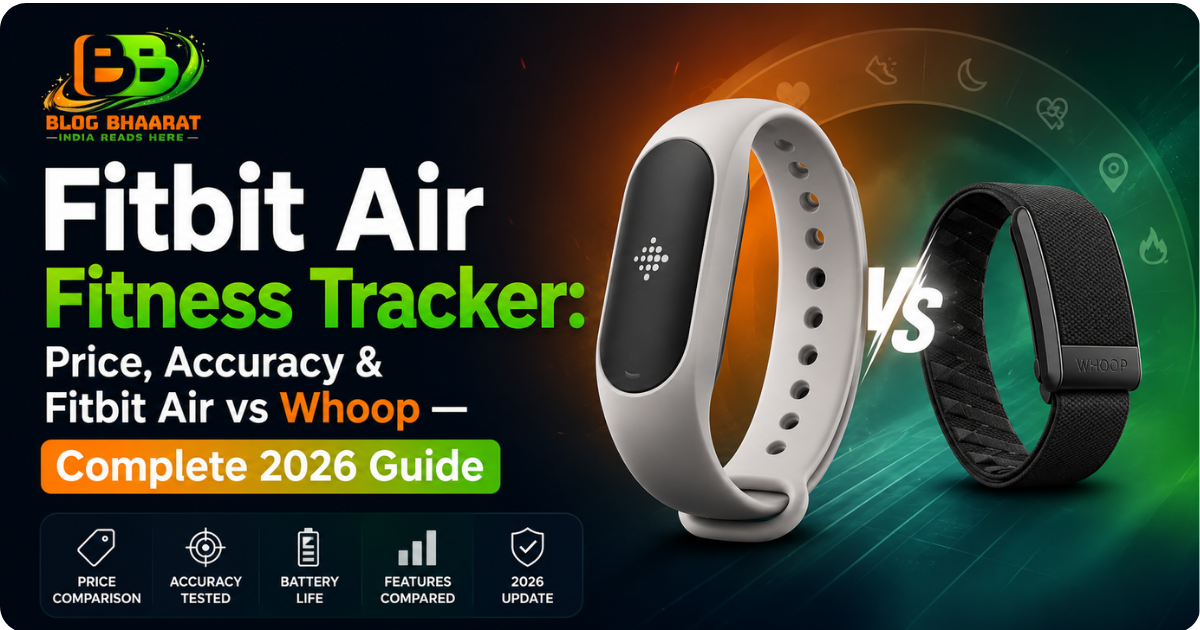
Why Fitbit Air Is the Most Talked-About Fitness Tracker of 2026
Imagine wearing a fitness tracker so light you forget it’s there — no screen glowing at your wrist, no buzzing notifications pulling you away from your workout, and no compulsory monthly subscription draining your wallet. That is exactly what the Fitbit Air fitness tracker promises, and from all early indicators, it delivers.
Launched by Google in May 2026, the Fitbit Air is a bold, minimalist leap forward in wearable technology. It sits in the fast-growing screenless fitness tracker category — a segment that saw a staggering 88% sales surge between 2024 and 2025 — and brings the trusted Fitbit brand into a space previously dominated by premium players.
Whether you are wondering about the Fitbit Air fitness price, curious about Fitbit Air accuracy, or trying to decide between Fitbit Air vs Whoop — this comprehensive, SEO-optimized guide covers everything you need to know in one place.
What Is the Fitbit Air? Google’s Screenless Health Revolution
The Fitbit Air is Google’s smallest, most affordable wearable yet. It is a screenless fitness band shaped like a tiny pebble that clips into a soft fabric or silicone loop band. The device has no display, no haptic buttons, and no push notifications — it simply sits on your wrist and tracks your health data 24/7, delivering all insights through the Google Health app on your smartphone.
This approach is a deliberate design philosophy: fewer distractions, more data, better health outcomes. The entire point of the Fitbit Air is to monitor your body continuously without ever demanding your attention.
Key Insight: Smartwatch fatigue is real. Millions of users are looking for wearables that track their health passively without turning into a second smartphone on the wrist. The Fitbit Air is Google’s direct answer to that demand.
The Fitbit Air positions itself as Google’s direct response to subscription-based screenless trackers that have dominated this niche for years — making it one of the most competitive launches in the wearables market in recent memory.
Fitbit Air Design and Build Quality: The Pebble That Disappears on Your Wrist
The Fitbit Air’s design is its most immediately distinctive feature. Here is what makes it stand out:
- Ultra-Lightweight Construction: The sensor itself weighs just 5.2 grams — and only 12 grams when combined with the band. That makes it 25% smaller than the Fitbit Luxe and genuinely lighter than most jewellery.
- Screenless Pebble Form Factor: No display means the entire surface is dedicated to sensors and comfort rather than glass and circuitry.
- Eco-Friendly Fabric Band: The default Performance Loop Band is made from recycled materials (at least 35% by weight), making it a sustainable choice for eco-conscious users.
- Water Resistance: Rated at 50 metres water resistance, the Fitbit Air is safe in the shower, pool, and open water swims — far exceeding what many users expect at this price point.
- Band Options: Multiple band styles are available starting at $34.99, including the sweat-resistant Active Band for gym use and the style-forward Elevated Modern Band for daily wear.
The most consistent feedback from early users is the “invisible” feel — particularly during sleep and running, where bulk and weight from traditional smartwatches are a constant irritation.
Fitbit Air Fitness Price: How Much Does It Cost in 2026?
The Fitbit Air fitness price is one of its most compelling selling points. Here is the complete pricing breakdown:
| Edition | Price |
|---|---|
| Fitbit Air (Standard) | $99.99 |
| Fitbit Air Special Edition (Stephen Curry) | $129.99 |
| Replacement / Additional Bands | From $34.99 |
| Google Health Premium (Monthly) | $9.99/month |
| Google Health Premium (Annual) | $99/year |
| Free Trial (Included with Purchase) | 3 Months |
What Does the Price Include?
When you purchase the Fitbit Air at $99.99, you receive:
- The Fitbit Air sensor and your choice of band
- Full access to core tracking features — completely free, forever
- A 3-month Google Health Premium trial (auto-renews at $9.99/month unless cancelled)
- Compatibility with both Android (11+) and iOS (16.4+) devices
The core free tier covers heart rate monitoring, sleep tracking, SpO2, HRV, step counting, and automatic workout detection. The Premium subscription unlocks the Google Health Coach AI, advanced recovery insights, adaptive fitness plans, and personalised health trend analysis.
Important Note for Buyers: The 3-month Premium trial offer is available for new and returning users until May 26, 2027. After the trial, core features remain fully functional without payment — the subscription is genuinely optional.
Fitbit Air Key Features and Tracking Capabilities
The Fitbit Air packs a comprehensive sensor suite into its tiny pebble form factor. Here is a full breakdown of what it tracks and how well it performs:
Health and Fitness Metrics Table
| Health Metric | Tracking Method | Included Free? | Accuracy Notes |
|---|---|---|---|
| Heart Rate (24/7) | Optical sensor, samples every 2 seconds | Yes | Excellent for steady-state; slight lag in high-intensity intervals |
| Sleep Stages | HRV + movement analysis | Yes | Highly detailed — deep, light, REM stages with nightly scores |
| SpO2 (Blood Oxygen) | Nightly average monitoring | Yes | Useful for detecting breathing irregularities overnight |
| HRV (Heart Rate Variability) | Continuous passive monitoring | Yes | Key recovery and stress indicator |
| Skin Temperature Variation | Overnight passive monitoring | Yes | Flags hormonal changes, illness, perimenopause symptoms |
| AFib Rhythm Alerts | ECG-adjacent monitoring | Yes | Clinically relevant for early heart rhythm detection |
| Breathing Rate | Sleep-phase analysis | Yes | Respiratory health tracking overnight |
| Automatic Workout Detection | Machine learning personalisation | Yes | Detects running, walking, cycling, rowing, elliptical + more |
| Cardio Load & Daily Readiness | Combined metric | Yes | Inherited from Pixel Watch 4 platform |
| Google Health Coach AI | Gemini AI-powered | Premium | Personalised adaptive plans, photo-based gym routines |
| Advanced Trend Insights | Long-term pattern analysis | Premium | Proactive health recommendations |
Auto-Workout Detection and Manual Logging
The Fitbit Air automatically detects running, walking, cycling, rowing, elliptical, and other high-heart-rate activities without any manual intervention. For more specific sports, the Google Health app supports manual logging for approximately 40 activity types and retrospective logging for over 140 activity types — including household tasks like gardening and cleaning.
The machine learning system improves over time as it learns your movement patterns, making auto-detection progressively more accurate with continued use.
Fitbit Air Accuracy: How Reliable Is the Data?
The Fitbit Air accuracy question is arguably the most important one for potential buyers. Here is what the data and real-world testing shows:
Heart Rate Accuracy
The optical heart rate sensor samples every 2 seconds and performs solidly during steady-state cardiovascular activity — walks, jogs, cycling, yoga, and low-to-moderate intensity workouts. During high-intensity interval training (HIIT) or rapid heart rate spikes, there can be a slight lag — which is a known limitation of wrist-based optical sensors across all brands at this price tier.
Sleep Tracking Accuracy
This is arguably where the Fitbit Air excels most. Sleep stage detection (deep, light, REM) and the accompanying nightly sleep score have received strong reviews from early users. The combination of HRV data, movement analysis, breathing rate, and skin temperature variation makes the sleep insights among the most comprehensive available in this category.
SpO2 and HRV Accuracy
Nightly average SpO2 monitoring and HRV measurements are consistent and useful for tracking long-term trends. These metrics are most valuable when monitored over weeks and months rather than individual nights.
Skin Temperature Accuracy
The skin temperature sensor is particularly noteworthy for its potential to flag early illness, hormonal fluctuations, and — importantly — vasomotor symptoms for women in perimenopause. The Google Health app uses temperature variation data in its female health tracking features, making this a genuinely differentiated health tool.
Overall Accuracy Verdict
For everyday fitness tracking, sleep monitoring, and passive health monitoring, the Fitbit Air delivers accuracy that is more than sufficient. For elite athletic performance monitoring requiring ultra-precise strain scoring and advanced biomechanical data, users with highly specific performance needs may find the sensor suite less granular than specialist athletic trackers.
Battery Life and Charging: A Week of Worry-Free Wear
Battery anxiety is one of the biggest pain points with wearable technology. The Fitbit Air directly addresses this:
- Standard Battery Life: Up to 7 days per charge in typical use
- Real-World Battery Life: Independent testing shows 5–6 days with heavy use (continuous notifications off, GPS-free)
- Fast Charging: A 5-minute charge delivers a full day of use — making it virtually impossible to be caught without battery, even for the most forgetful users
- Charging Method: Proprietary magnetic charging cable included
This battery performance significantly outpaces traditional smartwatches and screen-based trackers, which typically require charging every 1–3 days. The combination of a week-long battery and 5-minute fast charging is one of the Fitbit Air’s strongest practical advantages.
Google Health App: Your Dashboard for Every Health Insight
Since the Fitbit Air has no screen, the Google Health app is your complete window into your health data. This is not a limitation — it is actually an upgrade.
The revamped Google Health app (replacing the legacy Fitbit app) brings together:
- Centralised health dashboard for all tracked metrics
- Google Health Coach (Premium): Powered by Google’s Gemini AI, this feature creates adaptive, personalised fitness plans based on your health data. A particularly creative feature lets you photograph gym equipment and automatically generate a custom workout routine using what’s available.
- Recovery Insights and Daily Readiness Scores: Tells you how hard to push yourself each day based on your sleep, HRV, and activity history
- Seamless Google Ecosystem Integration: Pairs perfectly with Pixel Watch for hybrid smartwatch-plus-tracker use
- Full iOS Compatibility: iPhone users are fully supported via iOS 16.4+
The app’s design philosophy is to make health data actionable, not just informative — turning raw numbers into clear, specific recommendations about sleep, activity, and recovery.
Fitbit Air vs Whoop: The Complete Head-to-Head Comparison
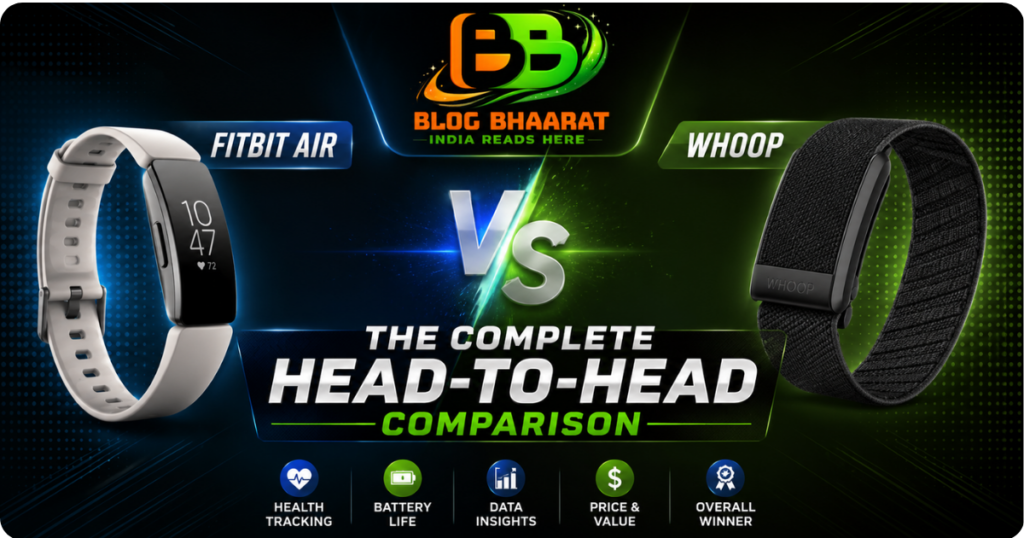
The most searched comparison in this category is Fitbit Air vs Whoop. Both are screenless fitness trackers focused on recovery and health monitoring. Here is an honest, detailed side-by-side analysis:
Fitbit Air vs Whoop — Feature Comparison Table
| Feature | Fitbit Air | Whoop 5.0 |
|---|---|---|
| Hardware Price | $99.99 (one-time) | Free with subscription |
| Subscription Required? | No — Optional | Yes — Mandatory |
| Subscription Cost | $9.99/month or $99/year | $30+/month (annual commitment) |
| Total Year-1 Cost (with sub) | ~$199 ($99.99 + $99 annual sub) | $200–$360+ (mandatory sub only) |
| Battery Life | Up to 7 days | ~5 days (pod system) |
| Water Resistance | 50 metres | 10 metres |
| Screen | None | None |
| Weight | 12g (with band) | ~13g (with strap) |
| Heart Rate Tracking | 24/7 continuous | 24/7 continuous |
| Sleep Tracking | Stages, score, breathing | Stages, disturbances, coaching |
| HRV Monitoring | Nightly + continuous | Advanced |
| SpO2 | Nightly averages | Continuous |
| Skin Temperature | Yes | Yes |
| AFib Alerts | Yes | No |
| AI Coaching | Google Health Coach (Gemini AI) | Whoop Coach |
| GPS | No built-in GPS | No built-in GPS |
| App Ecosystem | Google Health | Whoop App |
| iPhone Compatible | Fully | Fully |
| Best Suited For | Everyday users, Google ecosystem, budget-conscious | Serious athletes, performance-focused users |
The Key Difference: Cost Structure
The most important practical difference between Fitbit Air vs Whoop is the cost model. Whoop charges a mandatory monthly subscription — making the total cost of ownership significantly higher over 12–24 months. The Fitbit Air’s optional subscription model gives users a free, fully functional baseline with the choice to upgrade.
For users who simply want reliable sleep, recovery, and activity tracking without committing to ongoing monthly payments, the Fitbit Air is the more economical long-term choice.
For elite athletes who require highly granular strain scoring, advanced strain/recovery coaching deeply integrated into training schedules, and the most detailed biomechanical data available in a screenless tracker, specialist athletic trackers remain the professional standard.
Fitbit Air Subscription Plans: Is Premium Worth It?
The Fitbit Air’s free tier is genuinely comprehensive. Here is exactly what you get at each level:
Subscription Tier Breakdown
| Feature | Free (Base) | Google Health Premium ($9.99/mo or $99/yr) |
|---|---|---|
| Heart Rate 24/7 | ✅ | ✅ |
| Sleep Stages & Score | ✅ | ✅ |
| SpO2, HRV, Breathing Rate | ✅ | ✅ |
| Skin Temperature | ✅ | ✅ |
| AFib Alerts | ✅ | ✅ |
| Auto Workout Detection | ✅ | ✅ |
| Daily Readiness Score | ✅ | ✅ |
| Google Health Coach AI | ❌ | ✅ |
| Adaptive Fitness Plans | ❌ | ✅ |
| Proactive Trend Insights | ❌ | ✅ |
| Photo-Based Workout Builder | ❌ | ✅ |
| Google AI Pro/Ultra Bundle | ❌ | ✅ (bundle available) |
Is Premium worth it? If you are a motivated fitness user who wants AI-guided personalised coaching, the $9.99/month or $99/year cost is excellent value. If you simply want reliable passive health tracking, the free tier covers everything you need.
The included 3-month free Premium trial gives every buyer a genuine opportunity to evaluate whether the advanced features are worth the cost before committing.
Who Should Buy the Fitbit Air Fitness Tracker?
| User Profile | Buy Fitbit Air? | Reason |
|---|---|---|
| Fitness Beginners | Strongly Yes | Affordable entry, AI coaching, zero overwhelm |
| Sleep-Focused Users | Strongly Yes | One of the best sleep trackers available at this price |
| Google / Pixel Ecosystem Users | Strongly Yes | Seamless integration with Google Health, Pixel Watch pairing |
| Budget-Conscious Health Trackers | Yes | One-time $99.99 with free core features forever |
| Apple Watch / Smartwatch Owners | Yes (as companion) | Ideal lightweight sleep and recovery tracker paired with a smartwatch |
| Women Tracking Hormonal Health | Yes | Skin temperature data supports menstrual and perimenopause tracking |
| Casual to Intermediate Gym Users | Yes | Auto-workout detection, Cardio Load, Health Coach |
| Elite / Professional Athletes | Consider carefully | May want more granular strain/recovery data from specialised trackers |
| Users Who Prefer On-Wrist Display | Not ideal | No screen — all data is app-based |
| Serious Outdoor GPS Users | Not ideal | No built-in GPS; requires phone for route tracking |
Accessories, Band Options, and Customisation
The Fitbit Air’s interchangeable band system allows users to adapt the tracker from gym wear to formal wear effortlessly:
- Performance Loop Band — The default daily wear band, made from eco-friendly recycled materials
- Active Band — Sweat-resistant silicone for intense workout sessions
- Elevated Modern Band — A refined bracelet-style band for smart casual or formal settings
- Price: Additional bands start at $34.99
The ability to change bands without tools makes the Fitbit Air genuinely versatile — a rarity at this price point.
Availability and Where to Buy the Fitbit Air
- Official Launch Date: May 26, 2026 (US market)
- Pre-orders: Opened May 6, 2026 via Google Store
- Primary Retail Channels: Google Store, Amazon US
- Standard Price: $99.99
- Special Edition (Stephen Curry): $129.99
- International Availability: India and other markets expected in Q3–Q4 2026
Conclusion: Is the Fitbit Air Fitness Tracker Worth Buying in 2026?
The Fitbit Air fitness tracker is a genuinely impressive product that delivers on its core promise — reliable, passive health monitoring in the lightest, most comfortable package possible, at a price that makes it accessible to a mainstream audience.
At $99.99 with a free, fully functional base tier, 7-day battery life, 50-metre water resistance, and a comprehensive sensor suite covering heart rate, SpO2, HRV, sleep stages, skin temperature, and AFib alerts, the Fitbit Air represents exceptional value in the screenless fitness tracker category.
Fitbit Air accuracy is excellent for everyday fitness and health monitoring — covering the needs of the vast majority of users who want actionable data without the complexity and cost of professional-grade athletic trackers.
In the Fitbit Air vs Whoop debate, the Fitbit Air wins decisively on cost, affordability, water resistance, and battery life. For casual to intermediate fitness users, the Fitbit Air’s optional subscription model is a breath of fresh air in a category long dominated by mandatory monthly fees.
Bottom Line: If you want a distraction-free, comfortable, data-rich fitness tracker that genuinely disappears on your wrist — the Fitbit Air is the smartest buy of 2026.
Frequently Asked Questions (FAQs) About Fitbit Air Fitness Tracker
Q1. What is the Fitbit Air fitness tracker?
The Fitbit Air is a screenless, pebble-shaped fitness tracker launched by Google in May 2026. It monitors health metrics including heart rate, sleep, SpO2, HRV, skin temperature, and AFib alerts — all delivered through the Google Health app. It weighs just 12 grams with the band.
Q2. What is the Fitbit Air fitness price?
The Fitbit Air fitness price starts at $99.99 for the standard edition and $129.99 for the Stephen Curry Special Edition. Additional bands are available from $34.99. The optional Google Health Premium subscription costs $9.99/month or $99/year — but core features are free forever.
Q3. How accurate is the Fitbit Air?
Fitbit Air accuracy is strong for everyday health and fitness monitoring. Heart rate tracking is solid during steady-state exercise; sleep stage detection is highly detailed; and metrics like SpO2, HRV, skin temperature, and AFib alerts perform reliably. Like all wrist-based optical sensors, it may show slight delays during very high-intensity interval training.
Q4. Is there a subscription required for the Fitbit Air?
No — the Fitbit Air does not require a subscription. All core health features are permanently free. The optional Google Health Premium subscription ($9.99/month or $99/year) unlocks the AI Health Coach, adaptive fitness plans, and advanced insights. Every purchase includes a 3-month free Premium trial.
Q5. How does Fitbit Air compare to Whoop?
In the Fitbit Air vs Whoop comparison, the Fitbit Air wins on upfront cost ($99.99 one-time vs Whoop’s free hardware but mandatory $200+/year subscription), water resistance (50m vs 10m), and battery life (7 days vs ~5 days). Whoop offers more granular strain-recovery analytics suited to elite athletes. For casual to intermediate users, Fitbit Air is the more cost-effective choice.
Q6. How long does the Fitbit Air battery last?
The Fitbit Air battery lasts up to 7 days per charge. With heavy use (continuous health monitoring enabled), expect 5–6 days. A 5-minute fast charge delivers a full day of use, making low battery situations easily manageable.
Q7. Is the Fitbit Air compatible with iPhone?
Yes — the Fitbit Air is fully compatible with iPhone via the Google Health app, which supports iOS 16.4 and above. It is also compatible with Android 11 and above.
Q8. Does the Fitbit Air have GPS?
No — the Fitbit Air does not have built-in GPS. For route tracking during outdoor runs or rides, you will need to carry your smartphone. Users who need dedicated GPS tracking should consider a GPS-equipped running watch.
Q9. What bands are available for the Fitbit Air?
The Fitbit Air is compatible with three band styles — the Performance Loop Band (default, eco-friendly), the Active Band (sweat-resistant for workouts), and the Elevated Modern Band (bracelet-style for smart wear). Bands start at $34.99 and are easy to swap without tools.
Q10. When will the Fitbit Air be available in India?
The Fitbit Air launched in the US on May 26, 2026. International availability including India is expected in Q3–Q4 2026. Check the Google Store and authorised Indian retail channels for updates.


Leave a Reply