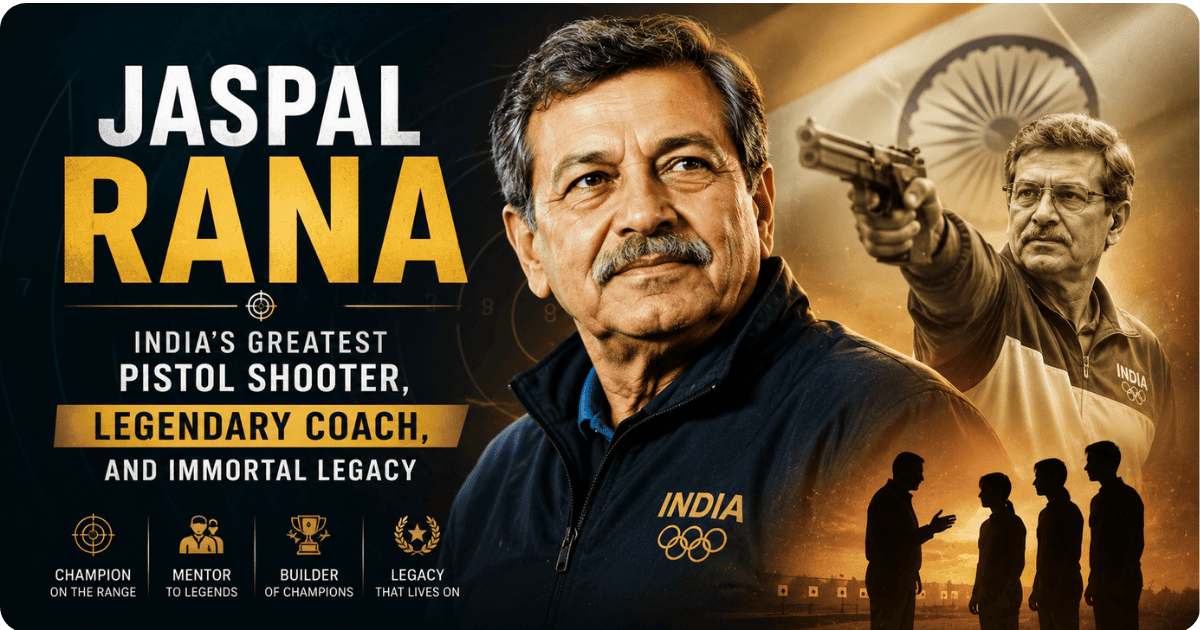
Jaspal Rana is one of the most celebrated names in Indian sports history. A pioneer of pistol shooting in India, Jaspal Rana transformed a niche discipline into a nationally recognised sport through sheer brilliance, decades of dedication, and a coaching career that helped create Olympic champions. Born on 28 June 1976 in Uttarkashi, Uttarakhand, Rana rose from a young boy introduced to firearms by his father — a former ITBP official — to become India’s most decorated Commonwealth Games athlete of all time. His legacy endures not only through his own record-breaking performances but through every medal won by the shooters he coached, most notably Manu Bhaker at the Paris 2024 Olympics.
Early Life and Introduction to Shooting
Jaspal Rana spent his formative years in Mussoorie, a hill station in Uttarakhand. His father, Narayan Singh Rana, served with the Indo-Tibetan Border Police (ITBP) and was Jaspal’s first and most influential shooting coach. At the age of ten, young Rana was introduced to both pistols and rifles. Though he trained with both weapons initially, he gravitated decisively toward pistol shooting — a choice that would define his extraordinary career.
His natural talent became apparent almost immediately. Just two years into the sport, at the age of 12, he made his national debut at the 31st National Shooting Championship in Ahmedabad in 1988 and clinched a silver medal — a remarkable achievement for someone so young. This early success signalled the arrival of a prodigious talent who would go on to redefine Indian shooting on the world stage.
Competitive Career: Record-Breaking Performances
1994 — The Breakthrough Year
The year 1994 was the most transformative in Jaspal Rana’s competitive career. He participated in the 46th World Shooting Championship (Junior Section) and won gold in the Standard Pistol event. Later that same year at the 1994 Milan World Shooting Championship, he set a record score that announced his arrival among the global elite. At the 1994 Commonwealth Games in Victoria, Canada, and the 1994 Asian Games in Hiroshima, Japan, he claimed gold medals in the 25m pistol events. His Asian Games gold was India’s first shooting gold at the Asiad in 16 years — a milestone that earned him the prestigious Arjuna Award in 1994 and the Padma Shri in 1997, making him one of the youngest Padma Shri recipients in Indian sporting history.
Commonwealth Games Dominance — A Record That Stands
Jaspal Rana’s performance at the Commonwealth Games is unparalleled in Indian sports history. Competing across four editions — 1994, 1998, 2002, and 2006 — he amassed a staggering 15 medals: 9 gold, 4 silver, and 2 bronze. This tally makes him India’s most successful Commonwealth Games athlete of all time, across all sports and all eras. His dominance across different pistol disciplines — the 10m Air Pistol, 25m Centre Fire Pistol, and 25m Standard Pistol — demonstrated a versatility that few shooters in the world have matched.
Table 1: Jaspal Rana — International Medal Summary
| Competition | Year / Edition | Gold | Silver | Bronze |
| Commonwealth Games | 1994, 1998, 2002, 2006 | 9 | 4 | 2 |
| Asian Games | 1994, 2002, 2006 | 4 | 1 | 0 |
| World Shooting Championship | 1994 (Milan) | 1 | 0 | 0 |
| National Championships | Multiple (1988–2010) | Multiple | Multiple | Multiple |
| TOTAL (International) | Across career | 14+ | 5+ | 2 |
Source: NRAI records, Wikipedia, Sports Reference
2006 Asian Games — The Crowning Moment
If the 1994 World Championship announced Rana to the world, the 2006 Doha Asian Games cemented his immortality. He delivered a sensational performance that included winning three gold medals and one silver — equalling the world record of the time in one of his events. It was the peak of his competitive career and arguably the finest individual shooting performance by an Indian athlete at any multi-sport Games.
World Records and National Championship Feats
Beyond international Games, Jaspal Rana was equally dominant on the domestic circuit. He equalled the world record score of 590 points in the 25m Centre Fire Pistol event on two separate occasions — at the National Shooting Championship in Coimbatore in 1995 and at the National Games in Bangalore in 1997. His consistency across multiple pistol disciplines — Air Pistol, Standard Pistol, Free Pistol, Rapid Fire Pistol, and Centre Fire Pistol — set him apart from all contemporaries.
Awards and National Honours
The Government of India and national sporting bodies recognised Jaspal Rana’s extraordinary contributions with the highest honours available to an Indian athlete:
Table 2: Jaspal Rana — Awards and Honours
| Award / Honour | Year | Significance |
| Arjuna Award | 1994 | India’s highest recognition for outstanding sports achievement |
| Padma Shri | 1997 | India’s fourth-highest civilian honour; awarded at age 21 |
| National Citizen Award | 1990s | Bestowed by Mother Teresa for national service through sport |
| Dronacharya Award | 2020 | Prestigious coaching award for contribution to Indian shooting |
| Olympian Recognition (OLY) | Ongoing | International Olympic Committee recognition of Olympic values |
Source: Ministry of Youth Affairs and Sports, Government of India
Coaching Legacy: Building Champions for India
Transition from Athlete to Coach
After retiring from elite competition, Jaspal Rana channelled all his expertise, discipline, and passion into coaching. He took charge of India’s junior national shooting team in 2012, beginning one of the most productive coaching tenures in Indian sports. Under his guidance, a new generation of pistol shooters emerged — including Saurabh Chaudhary, Abhishek Verma, and several other junior world champions — who put India firmly on the global shooting map.
Mentoring Manu Bhaker — An Olympic Legacy
The defining chapter of Jaspal Rana’s coaching career was his relationship with Manu Bhaker, who became one of the most celebrated Indian athletes of her generation. Their collaboration began in 2018. After a difficult period — including a public and painful separation during the Tokyo 2020 Olympics cycle — Rana and Manu Bhaker reunited ahead of the Paris 2024 Olympics. The results were historic. Under Rana’s mentorship, Manu Bhaker won two bronze medals at the Paris Olympics: one in the Women’s 10m Air Pistol individual event and one in the Mixed Team 10m Air Pistol event. This made her the first Indian athlete to win two medals at a single Olympic Games — a feat that would not have been possible without Rana’s technical expertise and motivational coaching.
Manu Bhaker later described the impact of her coach: whenever she saw Rana in the range, she felt greater courage and confidence — a testament to his extraordinary ability to build mental as well as physical shooting skills.
High-Performance Coach Role
Following the Paris 2024 success, Jaspal Rana was appointed India’s High-Performance Coach for the 25m pistol discipline under the National Rifle Association of India (NRAI). This role reflected both the shooting fraternity’s recognition of his coaching genius and his commitment to continuing the development of Indian shooting excellence at the highest level.
Personal Life and Family
Jaspal Rana came from a family steeped in the shooting tradition. His father, Narayan Singh Rana, remains one of the most influential figures of his life. His sister, Sushma Singh (née Rana), became an accomplished shooter herself, inspired directly by Jaspal, and won a gold medal at the 2006 Commonwealth Games. His brother Subhash Rana is also involved in the shooting world. Jaspal Rana is survived by his wife Reena Rana, their daughter Devanshi, and son Yuvraj.
Jaspal Rana’s Passing — June 2026
On the night of Thursday, 12 June 2026, Indian shooting lost its greatest ambassador. Jaspal Rana passed away at Max Hospital in Saket, South Delhi, at the age of 49 after battling cardiac complications. He had fallen ill during the Indian contingent’s return flight from the ISSF World Cup in Munich, Germany, and underwent a medical procedure in Delhi before his condition deteriorated. The news was confirmed by NRAI president Kalikesh Narayan Singh Deo and sent shockwaves through the Indian and global sports community.
At just 49, Rana’s death was a devastating and untimely loss. Tributes poured in from athletes, coaches, sporting officials, and fans across the country. Prime Minister Narendra Modi, sports ministers, and Indian Olympians acknowledged the immeasurable contribution he made to Indian shooting over more than three decades as both a competitor and a coach.
Jaspal Rana’s Enduring Legacy in Indian Shooting
The legacy of Jaspal Rana extends far beyond medals and trophies. He was the man who made pistol shooting aspirational for millions of young Indians. He broke barriers at a time when shooting lacked visibility in India, won gold on the world stage as a teenager, coached India’s most decorated Olympic shooter, and dedicated his entire life to elevating the sport he loved. The infrastructure he built — through his coaching academies, his role in junior development, and his influence on the NRAI — will continue to shape Indian shooting for decades to come.
India has produced many great athletes, but very few who have contributed simultaneously as a champion competitor, a national record holder, a world record equaller, an Olympic medal-winning coach, a Padma Shri recipient, and a Dronacharya awardee. Jaspal Rana did all of these things — and he did them with an unmistakable intensity, passion, and commitment to excellence that defines a true legend of Indian sport.
For authoritative information on Indian shooting, visit the National Rifle Association of India (NRAI) at nrai.org. For historical context on the Commonwealth Games records, the Commonwealth Games Federation provides verified medal data. Indian shooting fans can also explore resources at the Sports Authority of India (SAI) at sai.gov.in.
Frequently Asked Questions (FAQs) About Jaspal Rana
Q1. Who is Jaspal Rana?
Jaspal Rana (born 28 June 1976, Uttarkashi, Uttarakhand) was India’s most decorated Commonwealth Games athlete and one of the greatest pistol shooters in Indian history. He won 15 medals across four Commonwealth Games editions, four Asian Games gold medals, and a World Championship gold in 1994. He was also a highly respected coach who mentored Manu Bhaker to two Olympic bronze medals at Paris 2024. He passed away on 12 June 2026 due to cardiac complications.
Q2. How many medals did Jaspal Rana win at the Commonwealth Games?
Jaspal Rana won 15 medals at the Commonwealth Games — 9 gold, 4 silver, and 2 bronze — across four editions (1994, 1998, 2002, and 2006). This tally makes him India’s most successful Commonwealth Games athlete of all time, across all sports.
Q3. What is Jaspal Rana known for as a coach?
As a coach, Jaspal Rana is best known for mentoring Manu Bhaker to two bronze medals at the Paris 2024 Olympics, making her the first Indian to win two medals at a single Olympic Games. He also coached several junior world champions including Saurabh Chaudhary and was the high-performance coach for India’s 25m pistol team.
Q4. What awards did Jaspal Rana receive?
Jaspal Rana received the Arjuna Award (1994) — India’s highest sporting honour — the Padma Shri (1997) at the age of 21, a National Citizen Award from Mother Teresa, and the Dronacharya Award (2020) for his outstanding contributions to coaching Indian shooters.
Q5. How did Jaspal Rana die?
Jaspal Rana died on the night of 12 June 2026 at Max Hospital, Saket, New Delhi. He was 49 years old. The cause of death was cardiac complications. He had fallen ill on his return flight from the ISSF World Cup in Munich, Germany, and had undergone a cardiac procedure in Delhi before his condition worsened.
Conclusion
Jaspal Rana’s story is one of the most complete and inspiring in all of Indian sports. From a 12-year-old boy winning his first national medal in Ahmedabad to a 49-year-old high-performance coach preparing India’s finest pistol shooters for future Olympic glory, his journey spanned over three decades of unbroken dedication. He was a world record holder, a 15-time Commonwealth Games medallist, an Asian Games champion, a Padma Shri recipient, a Dronacharya Award winner, and above all, a builder of champions.
The impact Jaspal Rana had on Indian shooting cannot be quantified by medals alone. He inspired entire generations to pick up a pistol, to believe in their ability to compete with the world’s best, and to represent India with pride on the global stage. Manu Bhaker’s two Olympic bronze medals at Paris 2024 stand as his most recent monument — but his influence will continue to echo through Indian shooting for generations to come. India has lost a titan of sport, but the legacy Jaspal Rana leaves behind — in records, in medals, in champions, and in the hearts of every Indian shooting fan — is truly immortal.
You May Also Read – SpaceX IPO 2026: Date, Price, Stock Ticker & Everything You Need to Know
Follow Us On –Facebook, Instagram, Youtube, Twitter, Linkedin, Pinterest, whatsapp Channel